E-commerce in Poland: 137,000 online stores by platform, region and operator
 Michał Woźniak
27.10.2026
5 min read
This article is also available in Čeština.
Contents
Poland is the fastest growing large e-commerce market in the EU, and its online retail is unusually fragmented: tens of thousands of independent stores on local platforms, alongside the marketplaces. This article describes the market through the bazy.biz e-commerce database, which holds 137,000 online stores serving Polish customers, each verified as live in 2026 and matched, where possible, to the company behind it. We look at platforms, regions, legal forms and the sales infrastructure (payments, couriers, marketplaces) that the storefronts reveal.
The database in numbers
| Measure | Value |
|---|---|
| Online stores serving the Polish market | 137,447 |
| Stores in the whole database, including foreign-market stores | 169,377 |
| Verified live in 2026 | 100% |
| Matched to the operating company by tax number (NIP) | 71,177 (51.8%) |
| With a public e-mail address | 122,983 (89.5%) |
| With a public phone number | 102,158 (74.3%) |
| With filed financial statements of the operator | 18,556 |
Source: bazy.biz e-commerce database, October 2026. A store counts as serving the Polish market when it has a Polish language version, Polish payment or delivery options, or Polish prices. Stores are found by crawling platform fingerprints, DNS and technology scans, marketplace listings and search data, then revisited to confirm they are live. Foreign stores that merely ship to Poland are kept in the database but excluded from the figures below.
Platforms: WooCommerce first, then two Polish players
WooCommerce runs 39% of the stores with a recognised platform, which matches its position everywhere else in Europe. What is specific to Poland is the second tier. Shoper (19%, a Polish SaaS platform listed on the Warsaw stock exchange) and IdoSell (4%) are Polish systems, and together with Shopgold, Sky-Shop, SoteShop, Comarch and smaller local systems, Polish platforms run about 30% of the market. PrestaShop (16%) is stronger in Poland than in most countries because of a large base of Polish agencies that build on it. Shopify, at 6%, is small; its share is growing among new stores but it is far from the position it holds in Western markets.
For a software, payments or logistics vendor the platform split is the first targeting criterion: a Shoper or IdoSell store installs apps from the platform's marketplace, a WooCommerce or PrestaShop store needs a plugin and usually an agency, and a Magento or Shopware store (together about 5,400 stores, mostly the larger ones) has an IT team.
Where the stores are
Among the 71,000 stores matched to a registered operator, Masovia (Warsaw) has 15,300, followed by Silesia 8,500, Lesser Poland (Kraków) 8,000, Greater Poland (Poznań) 7,300 and Lower Silesia (Wrocław) 5,400. By city, Warsaw has 9,100 store operators, Kraków 3,300, Wrocław 2,600, Poznań 2,400 and Łódź 2,000. The distribution follows the general business population closely: the six largest regions hold two thirds of the stores, as they hold two thirds of all businesses.
Who runs them
| Legal form of the operator | Stores | Share |
|---|---|---|
| Sole proprietorship (JDG) | 42,700 | 59.9% |
| Limited liability company (sp. z o.o.) | 20,000 | 28.1% |
| Civil law partnership (s.c.) | 2,600 | 3.6% |
| General partnership (sp.j.) | 2,100 | 2.9% |
| Limited partnership (sp.k.) | 1,900 | 2.6% |
| Joint stock company (S.A.) | 800 | 1.1% |
| Foundations, associations, cooperatives, other | 1,200 | 1.7% |
Among stores matched to an operator. Compared with the economy as a whole, where 82% of businesses are sole traders and 14% limited companies, online retail skews towards companies: 28% of stores belong to an sp. z o.o. The 18,556 stores whose operator files financial statements in KRS can be filtered by revenue, which is the usual way to separate the long tail from the stores that matter commercially.
By activity code, 27,100 operators are registered as retailers (division 47) and 12,200 as wholesalers (division 46), which is to say that one in six stores is a B2B wholesaler with an online channel. The rest are manufacturers selling direct (clothing, furniture, food, other manufacturing), IT companies, training providers, advertising agencies and car parts dealers.
Payments, delivery and marketplaces
| Detected on the storefront | Most common | Stores |
|---|---|---|
| Payment providers | PayPal, Przelewy24, BLIK, PayU, Klarna, Dotpay, Tpay, PayPo | PayPal 27,000; Przelewy24 14,000; BLIK 11,000 |
| Couriers | InPost, DPD, FedEx, UPS, Poczta Polska, Orlen Paczka, Apaczka, Furgonetka | InPost 37,000 |
| Marketplace presence | Ceneo, Allegro, Amazon, OLX, Empik, Erli, Morele | Ceneo 5,700; Allegro 3,800; Amazon 230 |
Counts are of stores where the provider is visible on the storefront, so they understate the real usage; they are useful as relative measures. Three things stand out for a foreign reader. BLIK, the Polish mobile payment scheme, is now a standard checkout option. InPost parcel lockers dominate delivery so completely that a store without an InPost option is at a disadvantage. Allegro, the Polish marketplace, is where most independent stores also sell, while Amazon's presence in the storefronts of Polish stores is marginal.
Using the database
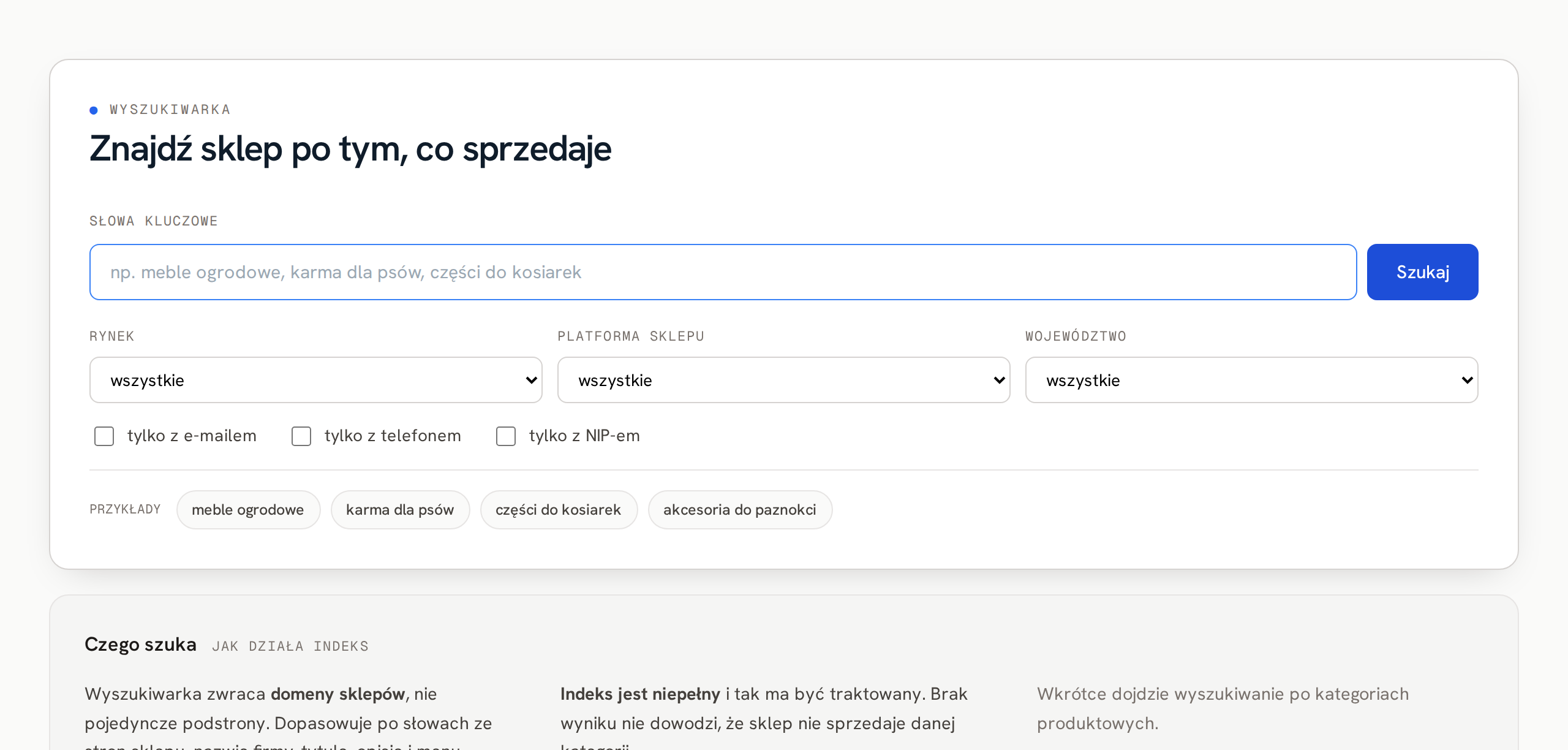
The typical buyers of a list of Polish online stores are payment and logistics providers, SaaS vendors for e-commerce, marketing agencies, wholesalers looking for resellers, and manufacturers looking for distribution. Each record carries the store URL, platform, category, detected payment and delivery providers, marketplace presence, and, where matched, the operator's name, NIP, legal form, address, activity code, founding date and public contact data. Lists can be filtered by any of these, and a Polish-market export can be limited to stores with an identified operator, which is the subset you can verify and invoice. Describe the segment you need and we will reply with the count and the price.
Figures are from the bazy.biz e-commerce database as of October 2026. Platform, payment and courier detection is based on storefront analysis and is not a statement by the stores or the providers.
Founder of bazy.biz. Over 20 years in data processing, marketing and business process automation.